Wed Mar 18, 6:37 AM
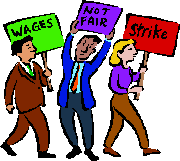
CALGARY (CBC) - A group of disgruntled workers at a recently closed auto parts supply company in Windsor, Ont. have taken over the plant.
In the latest bizarre twist in a saga that has been brewing since two auto plants in the area shut down early last week, about a dozen workers occupied the Aradco plant Tuesday night. They have welded the doors shut from the inside and say they will not leave until they get what they are owed.
Work at the Aradco plant stopped last week because of a dispute between the plant owners and Chrysler, which has mused publicly about pulling out of its Canadian operations unless unionized workers make substantial concessions.
The Canadian Auto Workers Union that represents the Aradco workers say that in the wake of the shutdown, the workers are owed money for severance pay, vacation pay, and termination pay totalling $1.7 million.
The plant's owner, Catalina Precision Products Ltd. has offered the workers four weeks of severance pay or about $200,000 in total for all 80 workers.
The plant builds parts for Chrysler. Since last week, Chrysler has been trying to go in and collect parts and tools it says are its, but the workers are not allowing it. They have been blocking trucks from coming on to the property. Union representatives say the workers fear that if the tools and parts are removed, they will have no negotiating power.
"Some of the workers here have decided to take over the plant. That's the only thing they have in order to try to get the monies that are owing to them," said Gerry Farnham, president of the CAW local representing the workers.
Wednesday, March 18, 2009


Wednesday, March 4, 2009
AFL-CIO Executive Council Day 2
Miami - Today started with a press conference on the Employee Free Choice Act. John Sweeney led off by saying that labor is united around EFCA as its number one priority. He said much of yesterdays discussion focused on labor’s mobilization strategy for passage. He cited in particular Randi Weingarten, president of the American Federation of Teachers, She told the council meeting of how the building trades had supported teachers in organizing their union in New York City. Weingarten said it is time for all unions, even those not specifically affected by EFCA, to return that kind of solidarity. She announced that the AFT is contributing $1 million to the campaign.
As an example of union mobilization Sweeney noted that next week the United Steelworkers are collecting 2000 hand written letters to Senator Arlen Specter (R-PA), this on top of 1000 letters already delivered last week.
EFCA, Democracy and the Economy
Larry Cohen, president of the Communication Workers of America, made strong points for EFCA as basic democracy and good for the country. He pointed out that of all the “democratic” countries in the Americas, North and South, the US and Colombia have the worst laws on collective bargaining. Most countries not only allow majority sign up for union recognition, but some don’t even require a majority. Cohen and others repeatedly stressed that passage of the EFCA is a basic component of economic recovery. Getting consumer demand broadly into the hands of working people is critical to generating production and economic activity.
Citing the New York drug store chain Duane Reade’s support for EFCA, Cohen mentioned a string of companies that are supporting the act or have called on business to remain neutral. It is a growing business push-back against the Chamber of Commerce and rightwing attacks.
Facts to Fight With
John Schmidt, of the Center for Economic and Policy Research, presented a new report detailing illegal firings to stop organizing campaigns: you can read it here.
Worker Highlight
 Philip Jackson (left) is a pipefitter apprentice and proud member of the United Association union. He was fired for discussing his union on the job. He is now unemployed and said that whenever he applies for a job he’s not hired because of his union membership.
 Angela Winningham is a Delta flight attendant who spoke of her experiences with management’s underhanded practices and intimidation tactics to defeat NLRB elections.
Today’s agenda includes a discussion on support for nationalizing failing banks and discussion of the on-going efforts to reunite the entire labor movement into one federation.
Stay tuned, more to come.
Tuesday, March 3, 2009
“There is a new sheriff in town.”

Hilda Solis meets with AFL-CIO Executive Council
Miami - The AFL-CIO Executive Council is holding it’s annual winter meetings in Miami this week. It’s no accident that one of their sessions was held in a IBEW local union hall in an economically hard hit section of the city.
The Executive Council met in closed session this morning with Secretary of Labor Hilda Solis. Then Solis, AFL-CIO president John Sweeney and IBEW president Ed Hill, went on a tour of an electrical workers apprenticeship training center. Last night Solis also participated in a forum sponsored by the Southern Florida AFL-CIO and Southern Florida Jobs w/ Justice. In both events she spent much of her time talking to rank and file workers. She asked them about their economic situations and spoke of the need to change the Department of Labor back to an agency that protects and promotes the rights of workers.
The meeting so far has focused on the economic crisis including jobs, healthcare, fair trade and protecting pensions and Social Security.
(More to come)
Tuesday, February 17, 2009
Confirm Hilda Solis Now!
Congresswoman Hilda Solis' confirmation to be our new Secretary of Labor is now scheduled for a "test" vote on Tuesday, February 24th, in the Senate. This means that she must get 60 votes to stop a filibuster before she can be confirmed.
The Republicans are fully mobilized by big business and the far right to try and prevent her confirmation. Her husband's taxes have nothing to do with it. They are determined to stop her nomination as a way of fighting against the Employee Free Choice Act. She, like President Obama, strongly supports the bill.
This is fully in keeping with the Republican's unsuccessful efforts to derail the economic stimulus package. In fact it is a continuation of the same Republican bankruptcy that pushes tax breaks for the rich and rejects public works and people helping spending. The ultra right in the Republican Party and big business fear Employee Free Choice because of the crucial role the legislation will play in economic recovery. It will mean they and the rich will have to settle for less to promote recovery. After all it was the profiteering of the Banks and big business that got us into this economic crisis.
Hilda Solis and passage of Employee Free Choice will spur economic recovery by raising wages and working conditions for millions of working families. This means good jobs/green jobs from the economic stimulus that get money circulating by creating demand for goods and services. The combination of a Secretary of Labor that actually represents the interests of labor and passage of Employee Free Choice are the best counterbalance to the greed and power of Wall Street and big business. They are our country's best bet for economic recovery.
Take Action Now:
Number 1: pick up the telephone and call 202-224-3121 (or use the toll-free service at 866-544-7573). Ask the Capitol operator to transfer you to one of your state's U.S. senators. When you're connected, say you're calling to urge your senator to urge her/him to vote to confirm Hilda Solis on February 24th.
Number 2: Get everyone you know to call. Take it to your union, your church, your community organization, block club - take this to everyone. Forward this to all your email lists.
Monday, February 16, 2009
Buy America - Bad Name, Good Policy
Political Affairs #93 - "Buy America" and the economic stimulus package
On this episode we discuss the "buy America" provisions of the president's economic recovery package with Communist Party Labor commission chair Scott Marshall.
On this episode we discuss the "buy America" provisions of the president's economic recovery package with Communist Party Labor commission chair Scott Marshall.
Saturday, January 17, 2009
UNIONS NEED UNITY, BUT MORE
By David Bacon
New America Media 1/12/09
OAKLAND, CA (1/10/09) -- Twelve unions met in Washington DC last week, and announced they're considering rejoining the two labor federations, the American Federation of Labor/Congress of Industrial Organizations (AFL-CIO) and Change to Win (CTW), that split apart five years ago. And one large independent union, the National Education Association, is thinking of joining them. The initiative came from the incoming Obama administration, which told union leaders it didn't relish the idea of dealing with competing union agendas.
Many progressive labor activists greeted the idea with a sigh of relief. "Dividing the labor movement was never a good idea to begin with," says Bill Fletcher, former education director for the AFL-CIO, and past president of TransAfrica Forum. Fletcher and many others believe that while U.S. unions have big problems, they can't be cured by division, competing federations, or simple changes in structure. Instead, they call for a reexamination of labor's political direction.
Unions are at their lowest point in membership since the 1920s, representing less than 12% of the workforce. Obama's election, which they pulled out all the stops to achieve, promises some degree of change from Federal policies that have accelerated that decline. The president-elect has appointed potentially the most pro-union labor secretary since the 1930s - Congresswoman Hilda Solis. A potential Congressional majority could pass the Employee Free Choice Act, which would make union organizing much easier and protect workers from retaliatory firings while they unionize. Obama has promised to sign the bill if Congress passes it.
In industry after industry, the impact of revived unions and growing membership could be enormous. For the first time in U.S. history, for example, unions have gained the strength to organize the rest of the hospital and nursing home industries. That would radically improve the jobs and raise the income of hundreds of thousands of nurses, dietary workers and bed changers, in the same way the CIO and the San Francisco General Strike turned longshoremen from day laborers on the waterfront into some of the country's highest-paid blue-collar workers. An organized healthcare industry, in alliance with consumers, could finally convince Congress to establish a single-payer system guaranteeing healthcare to every person in this country.
Yet while the 12 leaders were sitting down in Washington to discuss unity, the healthcare division of country's largest union, the Service Employees, may be torn apart in a fight between the union's national leaders and its largest local, United Healthcare West. Such a fratricidal conflict could not only jeopardize hopes for organizing healthcare workers, but even labor's larger political goals of the Employee Free Choice Act and single-payer healthcare.
Decisions made by unions often affect workers far beyond their own members. The labor upsurge of the 1930s and 40s led to national contracts in the auto, steel, longshore and electrical industries, establishing pension and medical benefits, raising wages, and forcing the creation of the unemployment insurance and Social Security systems. All workers benefited. And when many master agreements were destroyed in the early 1980s, workers' middle-class lifestyles began to erode everywhere.
Joining the AFL-CIO and CTW back together is a sensible step in marshalling the resources needed to take advantage of the openings presented by a new Obama administration, and begin rebuilding what was lost. But that larger sense of responsibility should inspire unions to face a basic question. They cannot rebuild their own strength, much less improve life for all workers, by themselves.
A new direction in labor requires linking unions with other social and economic justice movements. Defending immigrants from raids and helping them win legal status is just as important to the growth of unions as passing the Employee Free Choice Act. U.S. workers need a new trade policy, which stops using poverty to boost corporate profits abroad, impoverishing and displacing millions of people in the process. But that policy can't be won by unions negotiating with the administration by themselves, outside of a much broader coalition.
Health care reform requires an alliance between health care providers and working class consumers. The communities in which all workers live need real jobs programs and a full employment economy, especially Black and Latino communities. People far beyond unions will help win the Employee Free Choice Act and rebuild the labor movement if the it is willing to fight for everyone.
Unions need not just more unity and better organizing techniques, but a vision that will inspire workers. They need to speak directly to their desperation over insecure jobs, home foreclosures and falling income, and then lead them into action, even (or especially) if it makes a Democratic administration and Congress uncomfortable. As much as Obama has done labor a favor by forcing it to discuss reunification, political calculations in Washington can't be the guide to what is possible. Workers need a movement that fights for what they really need, not what beltway lobbyists say legislators will accept.
In the period of its greatest growth, labor proposed an alternative social vision that inspired people to risk their jobs and homes, and even lives - that society could be organized to ensure social and economic justice for all people. Workers were united by the idea that they could gain enough political power to end poverty, unemployment, racism, and discrimination. "Workers are looking for answers," Fletcher says. "Without them we'll get further despair. What we need instead is to organize for an alternative."
For more articles and images, see http://dbacon.igc.org
Tuesday, January 13, 2009
Unions take first steps to re-unite labor movement
By John Wojcik, People's Weekly World
The nations’ biggest labor unions are moving to bring all American unions back together under the umbrella of one national labor federation.
The presidents of 12 of the country’s largest unions called Jan. 7 for reuniting the labor movement, which split into two federations three years ago when seven unions left the AFL-CIO and formed Change to Win, a rival federation.
Participating in the unity meeting were the presidents of five of the Change to Win’s seven unions, six of the 56 AFL-CIO unions and National Education Association President Dennis Van Roeckel. His 3.2 million –member union is the nation’s largest and has always remained outside any larger labor federation.
The leaders made their joint call just two months after unions from both federations celebrated victory with the election of Barack Obama as president. Unions had already set aside their differences and built a united front for the elections.
Besides Van Roekel, in attendance at the meeting were AFL-CIO member union presidents Larry Cohen (Communications Workers), Leo Gerard (Steel Workers), Ron Gettelfinger (Auto Workers), Gerald McEntee (American Federation of State, County and Municipal Employees), Ed Hill (International Brotherhood of Electrical Workers) and Randi Weingarten (Teachers). Change to Win presidents attending were Joe Hansen (United Food and Commercial Workers), James Hoffa (Teamsters), Terry O’Sullivan (Laborers), Bruce Raynor (Unite Here) and Andy Stern (Service Employees). AFL-CIO President John Sweeney and Change to Win Chair Anna Burger were also there.
The Change to Win unions quit the AFL-CIO three years ago, asserting that the federation was not doing enough in the area of union organizing. Since that time, however, both federations have drawn closer together with both focusing on organizing and electoral work.
Leaders of several Change to Win unions have been saying for months now that they see little advantage in maintaining a separate labor federation.
The call for reunification came also after clear signals from President-elect Obama that labor’s interests would be best served in the coming period if there was a united movement.
David Bonior, a member of Obama’s transition team, helped arrange and participated in the reunification meeting that took place Jan. 7.
Dennis Gannon, president of the Chicago Federation of Labor, said Jan. 8, “This news is welcomed by local labor movements and stands to benefit all working people in this country. With a united labor movement, we will be in a better position to make real differences for working families across this great country.”
Many of the presidents of the unions involved reportedly expect, by April 15, to give the OK to a plan to reunify.
Some union leaders are saying, however, that its not a “done deal” and that the possibility of failure to reach an agreement remains.
Some union leaders have raised the possibility that instead of the Change to Win unions simply returning to the AFL-CIO, an entirely new organization might be launched.
The statement by the 12 union presidents at the unity meeting said: “The goal of the meeting is to create a unified labor movement that can speak and act nationally on the critical issues facing working Americans. While we represent the largest labor unions, we recognize that unity requires broad participation.”
Randi Weingarten, president of the American Federation of Teachers, is one of the leaders who attended and supports reunification. “There was a real sense of commitment to unifying our movement again,” she told the press. “It was clear that many of us felt that the whole is greater than the parts, and we really want to do things to help American workers get their rightful place in society.”
Many in the labor movement feel that there is a special need to push hard for unity at this time. With the nation facing its worse economic crisis since the Great Depression, they say, and with the election of a pro-labor president and Congress, the times call for labor to focus like a laser on solving the problems workers face. Passage of the Employee Free Choice Act, seen as critical to growing the labor movement, will not be possible, they say, without unprecedented unity in the ranks of labor. With that unity, they add, it will be possible to convince broad sectors outside the labor movement how critical growing union membership is to fixing the overall economy. That fix, according to labor, is a large number of workers able to spend a growing income on the goods and services produced.
Subscribe to:
Posts (Atom)